Even an Adult Benefited from ... Baa, a Duck!
A question before reading: Think about the reasons why an adult beginner might benefit from educational materials intended for children?
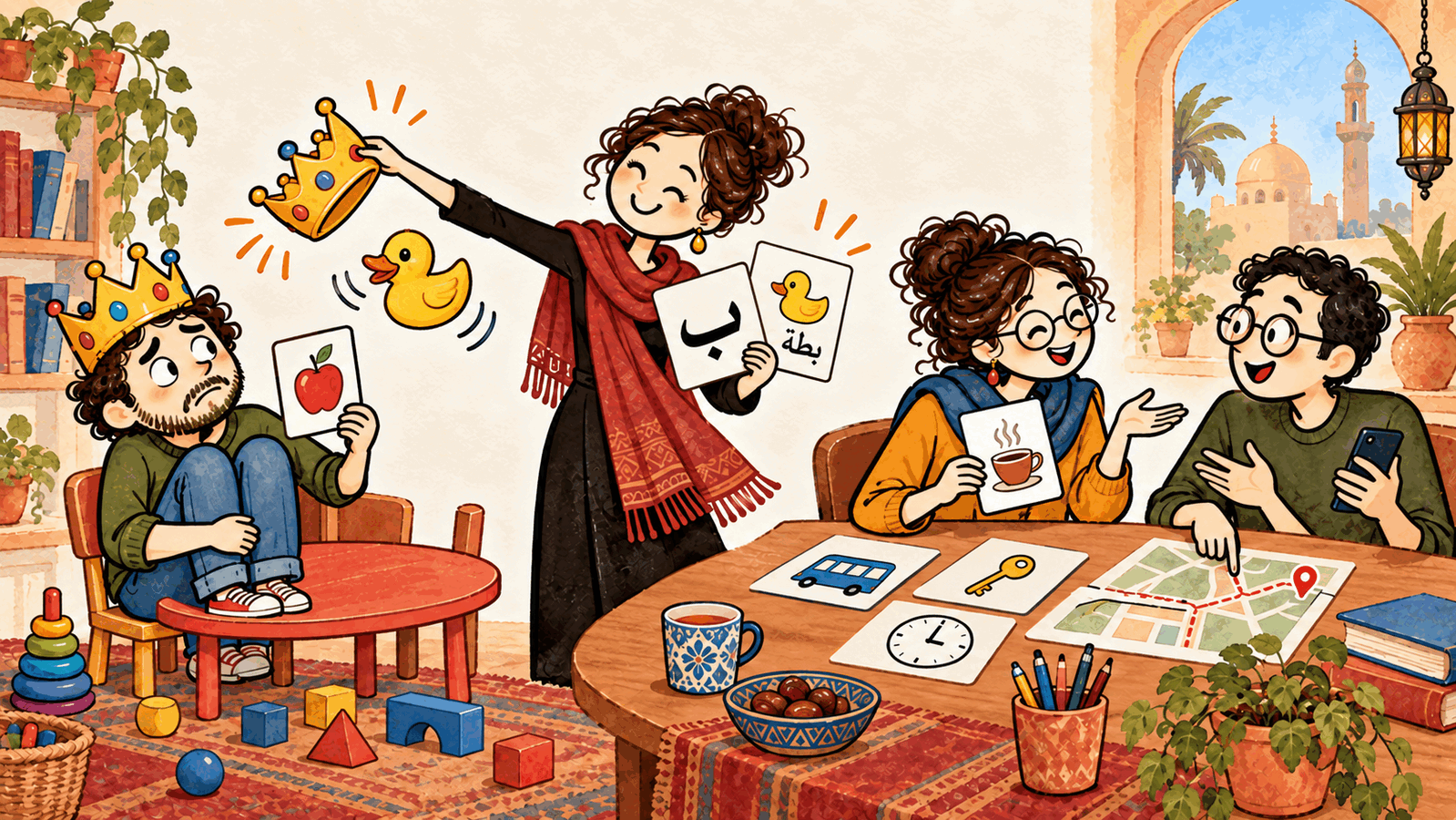
Let us imagine this scene:
A university student began learning Arabic a few days ago .. Then he found a page with a large picture of the letter baa, next to a picture of a duck. The picture may indeed help him connect the letter with its sound and shape, and it may stay in his memory longer than any lengthy explanation.
If you want to spoil the benefit for him, ask him to color in the duck 🦆🙃 Then clap because he completed the task!!! Congratulations .. Destruction complete!
The problem here is not the large baa, the lovable duck, or even that the material was originally made for a child. The problem is the way we address the adult learner!
In fact, children’s materials may contain things an adult beginner badly needs: a large letter, a clear picture, slow pronunciation, a short sentence, and persistent repetition that knows no embarrassment!
We may also find amusing illustrations, pleasant colors, and a story that is easy to follow without needing a dictionary in every line.
But they may also include topics that do not interest adults, exaggerated voices, instructions that assume the learner is a child, and activities that go no further than coloring, matching, and repeating.
So should we use these materials or leave them aside?
The short answer: Take their clarity, without adopting their way of treating a child.
A useful scientific study
In a study comparing forty children and forty adults learning a language invented for the experiment, some participants received explicit instruction and others received implicit instruction. The results showed that the type of instruction affected children’s and adults’ awareness of language structure in similar ways, and that differences we usually attribute to age may also be influenced by how the material is presented (Lichtman, 2016).
The study does not claim that an adult is a big child, nor did it test children’s materials or Arabic teaching. But it draws our attention to an important point: We cannot simply look at a learner’s age and immediately decide what kind of material suits them! How the material is presented, the type of activity, and the amount of explanation all affect how much learners benefit from it.
An adult may be a beginner at reading the letter baa, but is not a beginner at thinking, making decisions, or understanding human relationships. They may be a doctor, engineer, or researcher who can discuss a complex issue in their first language but cannot yet read the word «باب».
We should not confuse simple language with childish ideas.
Other studies: What happened when adults read picture books?
Lee Hsiang-Ni studied the experience of thirty-nine Taiwanese university students learning English after they used children’s picture books and varied reading activities over a semester. At the end of the experience, the students reported enjoying the books and feeling more confident and motivated (Lee, 2015).
This is an encouraging result, but not a definitive judgment; it relies largely on students’ opinions after the experience and does not, by itself, establish how much they learned.
In another study, a picture book was used with twenty-five university students learning English. The students did not merely read the story: they predicted events, compared their predictions with what happened, discussed the pictures, and collaborated in constructing meaning. The results showed linguistic, cognitive, and social engagement, with room for thinking and enjoyment rather than restricting the lesson to decoding words (Sun, 2015).
The most revealing study compared three ways of teaching eighty university students:
- Reading the picture book only.
- Reading the book with vocabulary explanations.
- Reading the book with collaborative output activities.
Vocabulary explanations were more useful on the test immediately after the lesson, but collaborative activities were more useful a month later for retaining words and using them productively (Sun, 2017).
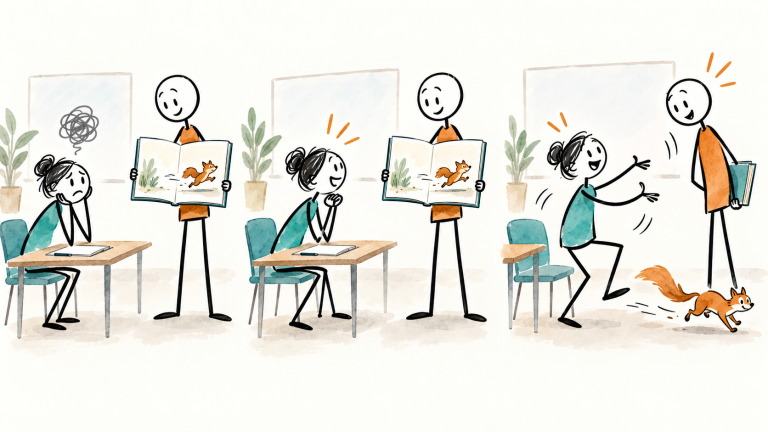
So the value did not come entirely from the book being illustrated. A significant part came from what the adults did with it: they discussed, predicted, produced, and collaborated.
And this is the central idea:
We may take the text from children’s materials, but we design the task for adults.
Pictures are no guarantee
But illustrations do not always help.
In an experiment with adult learners of English, less proficient learners benefited from comic strips when these accompanied a more difficult text, while the more proficient group did not improve in the same way (Liu, 2004).
A picture may distract learners if it is merely decorative, or if it presents the broad outline of the story while omitting important details in the text. We therefore do not choose children’s materials simply because they are colorful or amusing!
Before using children’s materials with an adult student, let us ask ourselves,:
- Does the picture actually help explain a word, an event, or a relationship?
- Is the pronunciation clear and natural, or so slow that it becomes distorted?
- Is the topic acceptable to an adult, even if its presentation is simple?
- Can I turn the activity into choosing, comparing, problem-solving, or exchanging information?
- Can I explain to the learner why we are using this material without embarrassment?
If the answers are reassuring, the material may be suitable, whatever the age of its original audience.
Try this in ten minutes
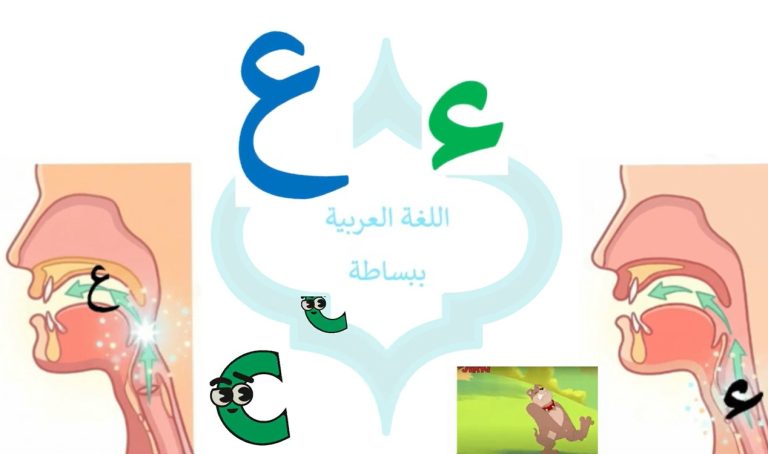
You can apply the idea using the letter baa video from The Arabic Alphabet Course on the Arabic Simply website.
The material was originally intended for children, but it can be adapted for adults as follows:
- The learner watches the part showing the letter, its sound, and how it is written.
- They look for baa in words from adult life, such as: بريد، بنك، كبير، مكتب، كتاب.
- They classify the words by the position of baa: at the beginning, in the middle, or at the end.
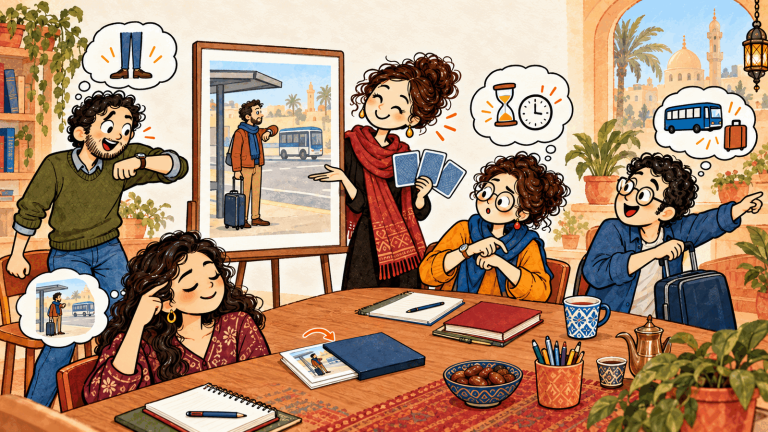
- They look at a simple map or a street picture, then look for بنك and مكتب بريد and طبيب.
- They work with a partner on a short dialogue:
– أين البنك؟
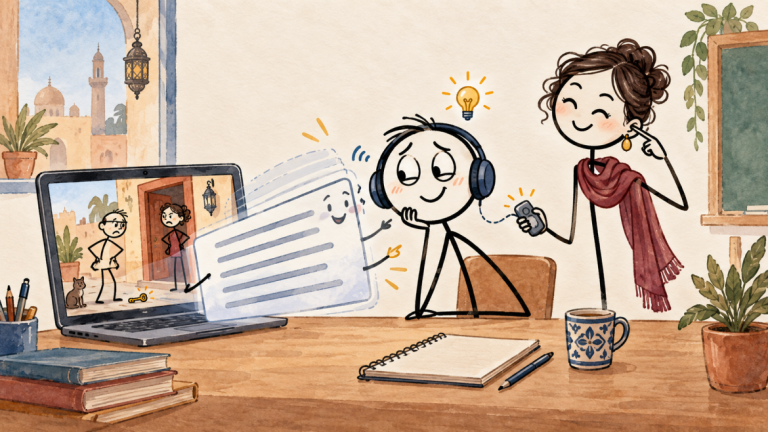
– البنك هنا. - Finally, they record a short voice message pronouncing three new words containing baa.
In this way, we have taken the clarity of the letter, the picture, the sound, and the repetition from children’s materials. We then added what suits an adult: reading a sign, using a map, asking about a place, and recording and reviewing their pronunciation.
Conclusion
“Is this material for children?” is an inadequate question. The more precise question is: Which part of it benefits a beginner, and what should I change to respect the adult’s mind and experience?
This week’s material: The Arabic Alphabet Course.
Have you ever used a children’s story or video with adult students? What worked, and what made them feel that the material did not suit them? We would be happy to hear your thoughts.
Join us in the next newsletter!
Arabic Simply
Even an Adult Benefited from ... Baa, a Duck!
A question before reading: Think about the reasons why an adult beginner might benefit from educational materials intended for children?
Let us imagine this scene:
A university student began learning Arabic a few days ago .. Then he found a page with a large picture of the letter baa, next to a picture of a duck. The picture may indeed help him connect the letter with its sound and shape, and it may stay in his memory longer than any lengthy explanation.
If you want to spoil the benefit for him, ask him to color in the duck 🦆🙃 Then clap because he completed the task!!! Congratulations .. Destruction complete!
The problem here is not the large baa, the lovable duck, or even that the material was originally made for a child. The problem is the way we address the adult learner!
In fact, children’s materials may contain things an adult beginner badly needs: a large letter, a clear picture, slow pronunciation, a short sentence, and persistent repetition that knows no embarrassment!
We may also find amusing illustrations, pleasant colors, and a story that is easy to follow without needing a dictionary in every line.
But they may also include topics that do not interest adults, exaggerated voices, instructions that assume the learner is a child, and activities that go no further than coloring, matching, and repeating.
So should we use these materials or leave them aside?
The short answer: Take their clarity, without adopting their way of treating a child.
A useful scientific study
In a study comparing forty children and forty adults learning a language invented for the experiment, some participants received explicit instruction and others received implicit instruction. The results showed that the type of instruction affected children’s and adults’ awareness of language structure in similar ways, and that differences we usually attribute to age may also be influenced by how the material is presented (Lichtman, 2016).
The study does not claim that an adult is a big child, nor did it test children’s materials or Arabic teaching. But it draws our attention to an important point: We cannot simply look at a learner’s age and immediately decide what kind of material suits them! How the material is presented, the type of activity, and the amount of explanation all affect how much learners benefit from it.
An adult may be a beginner at reading the letter baa, but is not a beginner at thinking, making decisions, or understanding human relationships. They may be a doctor, engineer, or researcher who can discuss a complex issue in their first language but cannot yet read the word «باب».
We should not confuse simple language with childish ideas.
Other studies: What happened when adults read picture books?
Lee Hsiang-Ni studied the experience of thirty-nine Taiwanese university students learning English after they used children’s picture books and varied reading activities over a semester. At the end of the experience, the students reported enjoying the books and feeling more confident and motivated (Lee, 2015).
This is an encouraging result, but not a definitive judgment; it relies largely on students’ opinions after the experience and does not, by itself, establish how much they learned.
In another study, a picture book was used with twenty-five university students learning English. The students did not merely read the story: they predicted events, compared their predictions with what happened, discussed the pictures, and collaborated in constructing meaning. The results showed linguistic, cognitive, and social engagement, with room for thinking and enjoyment rather than restricting the lesson to decoding words (Sun, 2015).
The most revealing study compared three ways of teaching eighty university students:
Reading the picture book only.
Reading the book with vocabulary explanations.
Reading the book with collaborative output activities.
Vocabulary explanations were more useful on the test immediately after the lesson, but collaborative activities were more useful a month later for retaining words and using them productively (Sun, 2017).
So the value did not come entirely from the book being illustrated. A significant part came from what the adults did with it: they discussed, predicted, produced, and collaborated.
And this is the central idea:
We may take the text from children’s materials, but we design the task for adults.
Pictures are no guarantee
But illustrations do not always help.
In an experiment with adult learners of English, less proficient learners benefited from comic strips when these accompanied a more difficult text, while the more proficient group did not improve in the same way (Liu, 2004).
A picture may distract learners if it is merely decorative, or if it presents the broad outline of the story while omitting important details in the text. We therefore do not choose children’s materials simply because they are colorful or amusing!
Before using children’s materials with an adult student, let us ask ourselves,:
- Does the picture actually help explain a word, an event, or a relationship?
- Is the pronunciation clear and natural, or so slow that it becomes distorted?
- Is the topic acceptable to an adult, even if its presentation is simple?
- Can I turn the activity into choosing, comparing, problem-solving, or exchanging information?
- Can I explain to the learner why we are using this material without embarrassment?
If the answers are reassuring, the material may be suitable, whatever the age of its original audience.
Try this in ten minutes
You can apply the idea using the letter baa video from The Arabic Alphabet Course on the Arabic Simply website.
- The material was originally intended for children, but it can be adapted for adults as follows:
- The learner watches the part showing the letter, its sound, and how it is written.
- They look for baa in words from adult life, such as: بريد، بنك، كبير، مكتب، كتاب.
- They classify the words by the position of baa: at the beginning, in the middle, or at the end.
- They look at a simple map or a street picture, then look for بنك and مكتب بريد and طبيب.
- They work with a partner on a short dialogue:
– أين البنك؟
– البنك هنا.
Finally, they record a short voice message pronouncing three new words containing baa.
In this way, we have taken the clarity of the letter, the picture, the sound, and the repetition from children’s materials. We then added what suits an adult: reading a sign, using a map, asking about a place, and recording and reviewing their pronunciation.
Conclusion
“Is this material for children?” is an inadequate question. The more precise question is: Which part of it benefits a beginner, and what should I change to respect the adult’s mind and experience?
This week’s material: The Arabic Alphabet Course.
Have you ever used a children’s story or video with adult students? What worked, and what made them feel that the material did not suit them? We would be happy to hear your thoughts.
Join us in the next newsletter!
Arabic Simply