
Vowel Marks: A Crutch or a Path to Reading?
How do you read «كتب» or «كتاب»?!
How do you read «كتب» or «كتاب»?!
Without vowel marks and context, it is up to you and me. An active verb? Possibly. Or a passive one? Possibly. Or the plural of «كاتِب»? Also possible.
When context appears, it usually removes the ambiguity and helps the mind decide. (The leading writers gathered at the memorial for the poet so-and-so). The meaning is clear.
But is context always a cure, especially for a beginner who does not know many of the surrounding words and has not yet firmly grasped the meanings of word patterns?!
Teachers hold different views. Some believe the entire text should carry vowel marks, with students spending enough time on it to establish the connection between the marks and their indications of word patterns and grammatical positions. Others fear that students will become dependent on the marks and later be unable to read a newspaper, a book, or an ordinary message.
So are vowel marks a help or a hindrance? The ready answer may be that it is best to begin with marks that reveal pronunciation, then gradually reduce them as learners become more able to use clues from vocabulary, morphology, grammar, and context.
In this sense, vowel marks are temporary support.
This idea of gradual progression is reasonable, because vowel marks serve more than one function
Marks within a word may distinguish different meanings: عَلِمَ – عِلْم – عَلَم
The shadda may change a word’s structure: دَرَسَ – دَرَّسَ, and vowel marks may distinguish active from passive:
كَتَبَ – كُتِبَ, while the final mark may indicate the word’s function in the sentence: الطَّالِبُ – الطَّالِبَ – الطَّالِبِ
A beginner’s need for these marks is not equal. They may need the shadda and internal vowels to recognize the word, while pronouncing the case ending of every word may not be the lesson’s aim at all.
Our decision should therefore not be limited to two options:
- Adding vowel marks to every letter in every text.
- Or removing all vowel marks from the start.
There is considerable room between them that might be called: gradual, functional vowel marking.
Whatever the case, the findings of some scientific studies may agree or disagree with the above,
One of the strongest studies directly related to our question involved fifty-four English-speaking learners, distributed across beginner, intermediate, and advanced levels. The study aimed to measure the effect of vowel marks on reading speed, reading accuracy, and reading comprehension. Students were selected to have equal or very similar prior knowledge of Arabic.
Half the students then learned Arabic from a series containing vowel marks (Ahlan wa Sahlan), while the other half learned from books that reduce vowel marks early (Al-Kitaab fii Ta‘allum al-‘Arabiyya). After studying, participants were asked to read word lists and texts in two conditions: once with vowel marks, and once without.
The results showed that those accustomed to vowel-marked materials performed better than their counterparts at all three levels (beginner, intermediate, and advanced). They read individual words faster, read target words in texts more accurately, and understood their meanings better. Beginners and intermediate learners in this group also read texts faster.
But the most important result came when the vowel marks were removed.
The performance of those who learned from vowel-marked books did not decline. They retained their advantage even when reading without vowel marks (Al Midhwah & Alhawary, 2020).
This finding weakens the hasty argument that visible vowel marks during learning leave students unable to read without them. The result seems to show that students accustomed to vowel marks did not learn only to read marked texts; rather, they appear to have formed a more accurate representation of the sounds of words, which also helped them when the marks disappeared.
What next? The study still does not settle the entire issue. It involved only fifty-four participants, all English speakers.
Nevertheless, it offers important evidence: fear of vowel marks is not sufficient reason to remove them from teaching materials.
We undoubtedly need further studies to confirm, correct, or contradict these findings.
Reading a word is not understanding a text
Suppose a student reads the following sentence correctly:
عادَ الْمُوَظَّفُ إِلَى مَكْتَبِهِ بَعْدَ الاِجْتِماعِ.
They pronounce every vowel, pause in the right place, and do not make a single sound error.
Then we ask: Where was the employee? And what happened before he returned?
They have not understood.
In contrast, another student may understand that the employee returned to his office after the meeting, but omit a final vowel or make a mistake in a case ending.
Which student read better?
The answer depends on what we are measuring: correct pronunciation? Word recognition? Understanding meaning? These things are related, but they are not the same.
In a study involving sixty-five adult native Arabic readers, vowel marks improved reading accuracy, and comprehension of vowel-marked Arabic text was better than comprehension of unmarked text. However, no significant positive relationship appeared between oral reading accuracy and comprehension (Abu-Rabia, 2001).
This does not mean that pronunciation is unimportant. It means a student may devote their attention to producing every vowel without understanding the text. They may also understand the general meaning from words and context while still making pronunciation errors.
Perhaps it is better, then, to vary our activities and goals:
If the goal is pronunciation, we focus on accurate reading. If the goal is reading comprehension, we should not make success depend on pronunciation accuracy. It is best to combine both goals, without imagining that they are one goal.
Why not add vowel marks to everything, all the time? (Another study and new findings)
If vowel marks are useful, why not keep them in all materials through the highest level?
Because a reader does not remain a beginner, and most of what they will read outside the textbook will not have vowel marks.
As readers gain experience, they begin recognizing words by their overall shape and drawing on roots, patterns, structure, and expected meaning. Extra marks on familiar words may turn from necessary information into visual details they ignore, and may even slow them down.
In a study involving seventy-five eighth-grade students, all skilled native Arabic readers, participants read vowel-marked words, unmarked words, and invented words without meaning.
Unmarked words were read faster and more accurately than marked words, and invented words were the hardest. This finding differed from several earlier studies that found benefits from vowel marks.
The researcher noted that participants had become accustomed to unmarked text and had not worked with fully marked text for years. They may therefore have read familiar words as whole forms, while vowel marks forced them to process signs they no longer needed (Ibrahim, 2013).
This study does not say that removing vowel marks is more useful for foreign beginners. The participants were skilled Arabic readers, and the task involved reading isolated words quickly, not learning new vocabulary or understanding a long text.
But it draws attention to the fact that the benefits of vowel marks vary with the reader and the task.
What helps a beginner today may become unnecessary once they know the word well. What helps with oral pronunciation may not help in the same way during fast silent reading.
From full to selective vowel marking
In another study, forty-eight English-speaking learners read Arabic verbs in the active and passive voice. Verbs were shown with full vowel marks, partial vowel marks, and no vowel marks, sometimes in context and sometimes alone.
Vowel marking improved reading speed, accuracy, and comprehension across proficiency groups. Partial vowel marking showed clear benefits, particularly for reading accuracy and understanding meaning. Context improved comprehension, but did not improve reading speed and accuracy in the same way (Aljohani, 2022).
We should not stretch this finding beyond what it supports: the study is a doctoral dissertation, the number of participants is limited, and the task was restricted to a specific set of verbs.
But it strengthens the idea of gradual progression. The transition need not be a leap from a fully marked text to one with no marks. We can pass through an intermediate stage, placing marks where they serve a purpose and removing them where the learner can manage without them.
What do the studies not say?
The studies do not provide a single timetable for removing vowel marks from Arabic textbooks.
Nor do they say that every beginner needs the same amount. A Persian or Urdu speaker, for example, may have prior experience with Arabic script that a speaker of a language using Latin letters does not. One learner may know spoken Arabic but be unable to read it, while another begins learning sounds, script, and vocabulary together.
The studies do not establish that marking an entire text is best for every activity. Marks that help when learning a new word may be unnecessary when reading a word that has appeared twenty times.
Nor do they establish that exposure to marked text alone is enough to prepare learners to read newspapers, messages, and websites. They must actually practice reading unmarked text.
It is closer to the truth to say:
- Beginners need more vowel marks when learning letter sounds and new words.
- Marks that prevent real ambiguity should be retained.
- Marks can be reduced on familiar words before new ones.
- Learners should sometimes see the same text in both marked and unmarked versions.
- The transition is not complete until learners practice using vocabulary, morphology, and context to compensate for what has been removed.
Let us always ask:
Which marks does this learner need to perform this task at this stage?
Let us reflect while preparing the text:
- What is the activity’s goal: learning sounds, recognizing words, or understanding meaning?
- Which new words does the student not yet have a sound representation for?
- Where is there genuine ambiguity between two readings?
- Which words have appeared often enough for their shapes to become familiar?
- What information can the student infer from the sentence?
- How much unmarked text have they already practiced with?
- What is the next step through which you will reduce support?
With these questions, vowel marking becomes an instructional decision rather than a typographical habit.
Try this in ten minutes
The idea can be applied using the fatha lesson from I Can Simply Read. The series presents fully vowel-marked words for beginners, but teachers can use it for gradual practice in removing marks (with adult learners).
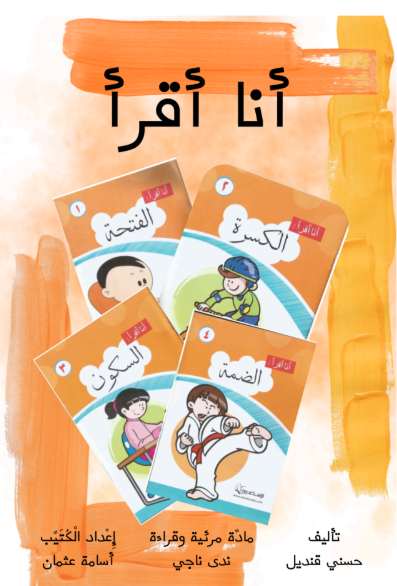
Link to the booklet accompanying the series
Choose four words the learner knows from the lesson, then follow these steps:
- Listen and look.
The learner looks at the marked words and hears their pronunciation, then reads them aloud. - Create a ladder of vowel marks.
Write the word in three forms, such as:
كَتَبَ ← كَتَب ← كتب
Do not ask them to read the final form immediately. Let them first notice what information disappeared at each step. - Put the word in context.
Show these sentences:
كَتَبَ سامِرٌ رِسالَةً.
اِشْتَرَى سامِرٌ كُتُبًا.
كُتِبَ الاِسْمُ هُنا.
Then discuss what helped choose the appropriate reading in each sentence. - Move to partial vowel marking.
كَتَبَ سامر رسالة.
اشترى سامر كُتُبًا.
كُتِبَ الاسم هنا.
Here the marks remain on the target word and disappear from familiar words. - Hide all the vowel marks.
كتب سامر رسالة.
اشترى سامر كتبا.
كتب الاسم هنا.
The learner reads the sentences using what they know about meaning and structure, then compares their reading with the first version. - Test transfer.
Present a new, unmarked sentence containing one of the words, and ask the learner to record it in their own voice. After recording, they uncover the marked version and correct themselves.
This gradual process reveals the difference between removing help and training students to become independent.
Conclusion
Vowel marks can be a crutch when we leave learners dependent on them, or a path when we teach learners how to move beyond them.
This week’s material: The fatha lesson and the lessons that follow it in I Can Simply Read.
At what stage do you begin reducing vowel marks with your students? What tells you they are ready for the next step?
Join us in the next newsletter,
The Arabic Simply team