
Should We Turn Subtitles On or Off?
The student laughed before the teacher.
They were watching a short clip in Arabic, with English subtitles running regularly along the bottom of the screen in time with the spoken text.
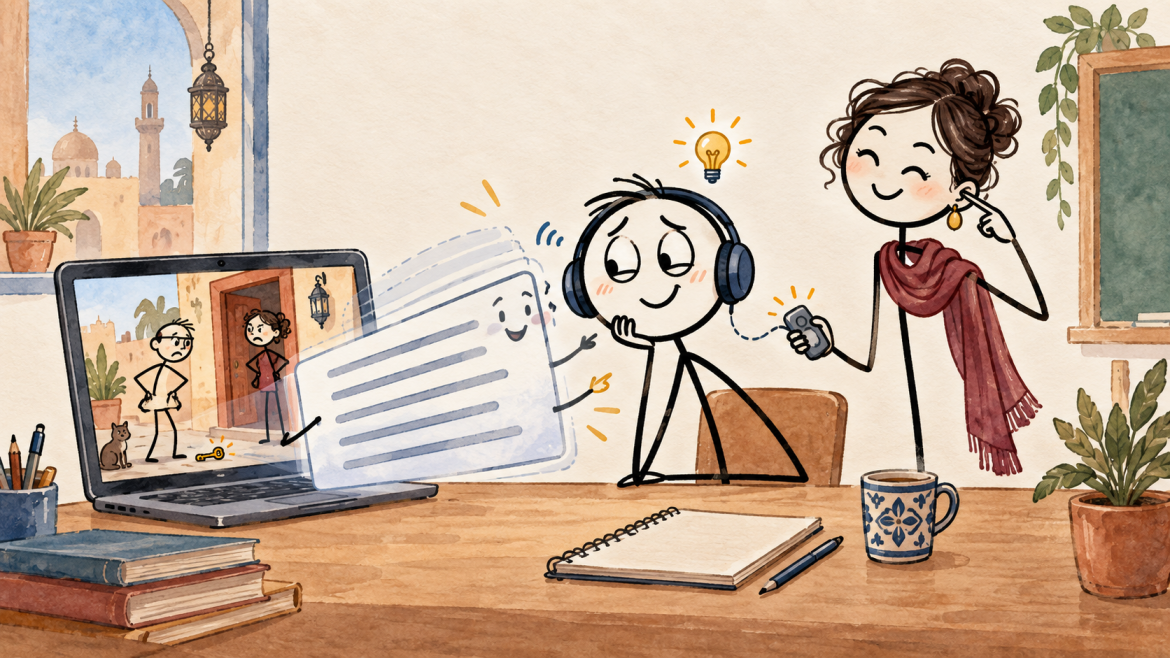
The student laughed before the teacher.
They were watching a short clip in Arabic, with English subtitles running regularly along the bottom of the screen in time with the spoken text.
The teacher said:
– What did the man say?
The student said:
– I don’t know, but his wife is angry, and he forgot the key!
They understood the whole story, except for the words spoken in Arabic.
The subtitles had been a very diligent student; they answered on the learner’s behalf! 🙃
Then, in another scenario, the teacher turned off both translated subtitles and same-language captions from the very first second and told the students: “Train your ears.” They did indeed train them—to tolerate ambiguity. They nodded solemnly, without knowing where one word ended and another began.
Teachers thus hold different views: one group turns subtitles on so learners do not get lost, and another turns them off for fear that learners will remain trapped in them forever.
Should we turn them on or off? Perhaps the answer is: It depends on what we want students to learn at that particular minute.
Not all text below a video is a translation
First, we need to distinguish three situations:
- Arabic audio with subtitles in the learner’s language: These help with understanding the meaning and the story.
- Arabic audio with accompanying written Arabic captions: These connect what is heard with what is written and help identify words in the video’s rushing stream of speech.
- Arabic audio alone: This reveals what learners can understand through their ears without support.
Students may therefore succeed in the first condition and fail in the third without contradiction. They understood the meaning through their own language but have not yet recognized the Arabic words.
They may also read the Arabic text quickly and think they heard it; when the text disappears, half the understanding disappears with it.
The button itself is therefore not a teaching method. The real test is the task that precedes and follows viewing.
What does the research say?
A 2013 meta-analysis examined eighteen studies on the effect of text accompanying videos. It found a large effect of target-language text on listening comprehension and vocabulary learning, but the studies were few and varied, and they did not all investigate the same question (Montero Perez et al., 2013).
This was followed by a newer, broader analysis of forty-nine independent experiments. Researchers compared learners who watched videos with written subtitles (captions) with learners who watched without them, then measured how much vocabulary they learned. The overall result was g = 0.56, a moderate value. What does 0.56 mean?
Learners who watched videos with captions outperformed the others by about half a standard deviation on average. You can picture it this way: The average student in the caption group outperforms approximately 70% of the students in the other group.
In other words, target-language text was found to improve incidental vocabulary learning moderately overall, rather than exceptionally.
Captions were more helpful when the material was originally made for language learners, and less helpful for some beginners who could not read the text quickly enough. Evidence that the effect persists over time was weaker: only eight of the studies included in the analysis contained delayed tests (Kurokawa et al., 2025).
This corrects two common statements:
- “Text always distracts students”; this is not true.
- “Put the text on, and the words will enter by themselves”; this is not true either.
As for subtitles in the learner’s language, two exploratory studies compared translated subtitles with captions in the language of the video. Gains from translation were generally small, while captions in the video’s language were associated with greater learning of word forms. Translated subtitles did not outperform captions on meaning tests either. Learning was also related to students’ vocabulary size and the number of times a word appeared in the clip (Peters et al., 2016).
But both studies were small and involved learners of English, so we should not hang their findings on the door of every Arabic classroom. They nevertheless draw attention to something important: understanding a story, learning its words, and recognizing their sounds are different things.
Translation is a passage, not a place to stay
If a clip is above the student’s level, translation may prevent the meaning from collapsing entirely. That is useful, but keeping it on for every viewing may accustom learners to following their familiar language with their eyes while Arabic passes overhead like clouds.
The solution is not to punish them with ambiguity, but to vary the amount of help:
- Turn on a short translation if the situation cannot be understood.
- Replace it with Arabic text when the goal is to connect sound with the word.
- Hide the text when we want to test listening.
- Bring it back after the attempt for correction, not decoration.
This way, translation is not forbidden, and turning it off is not an act of teaching heroism.
What do the studies not say?
They do not say that Arabic text helps someone who has not yet learned to read.
Nor do they say that a student’s success while the text is visible proves listening comprehension.
Nor do they say that one viewing is enough to establish a new word.
Nor do they offer a magic sequence that suits every clip and every level. Speech rate, vocabulary difficulty, reading ability, and the activity’s purpose all change the outcome.
Do not ask: On or off?
Ask instead:
- Do I want understanding of the story, recognition of words, or a listening test?
- Is the displayed text Arabic or a translation?
- Can the student read it before it disappears?
- What do they understand if I hide it?
- Are they trying to listen, or only reading?
- When will I remove the help, and when will I bring it back for correction?
If we do not know the button’s purpose, turning it on and off becomes a kind of organized futility.
Try this in ten minutes
Choose six words from a short lesson in I Can Simply Read. The series combines vowel-marked words, pictures, and pronunciation, progressing through short vowels, long vowels, tanween, and shadda.
- Sound and picture – two minutes
Play the word without showing its written form. The learner chooses the appropriate picture. Translate only the word whose meaning genuinely remains unclear. - Sound and the Arabic word – two minutes
Show the vowel-marked word and replay the audio. The learner reads along, then identifies the letter or vowel they did not hear the first time. - Hide the picture – two minutes
Show three words and pronounce one. The learner chooses what they heard. Here we test the connection between sound and written form. - Hide the word – two minutes
Show only the picture and ask the learner to recall the word. If they struggle, give the first sound rather than the full translation. - Hide everything – two minutes
Pronounce the words in a new order, or put two of them into two short phrases. The learner chooses the picture or writes what they heard, then uncovers the vowel-marked version and corrects themselves.
In ten minutes, help was used and then disappeared, and we learned something that viewing with translations does not tell us:
What part of the Arabic remained when the screen was empty?
Conclusion
Translation may rescue meaning, but it may do all the work if we always leave it on. Turning it off may reveal a student’s ability, but it does not create that ability out of nothing.
It is better to make support flexible:
Translation when meaning is needed, Arabic text to connect sound with the word, then a blank screen to test listening.
Turn on translation when it prevents darkness. Replace it with Arabic text when you want students to see what they hear. Then turn both off when you want to know what they have actually learned.
This week’s material: A suitable lesson from I Can Simply Read, provided the learner already knows its letters and target vowel.
When do you feel that translation helps your students, and when do you notice that it has begun speaking on their behalf?
Join us in the next newsletter,
The Arabic Simply team