
Repetition Helps .. How Many Times? 🤪🧠🔂
Why repeat the same story?
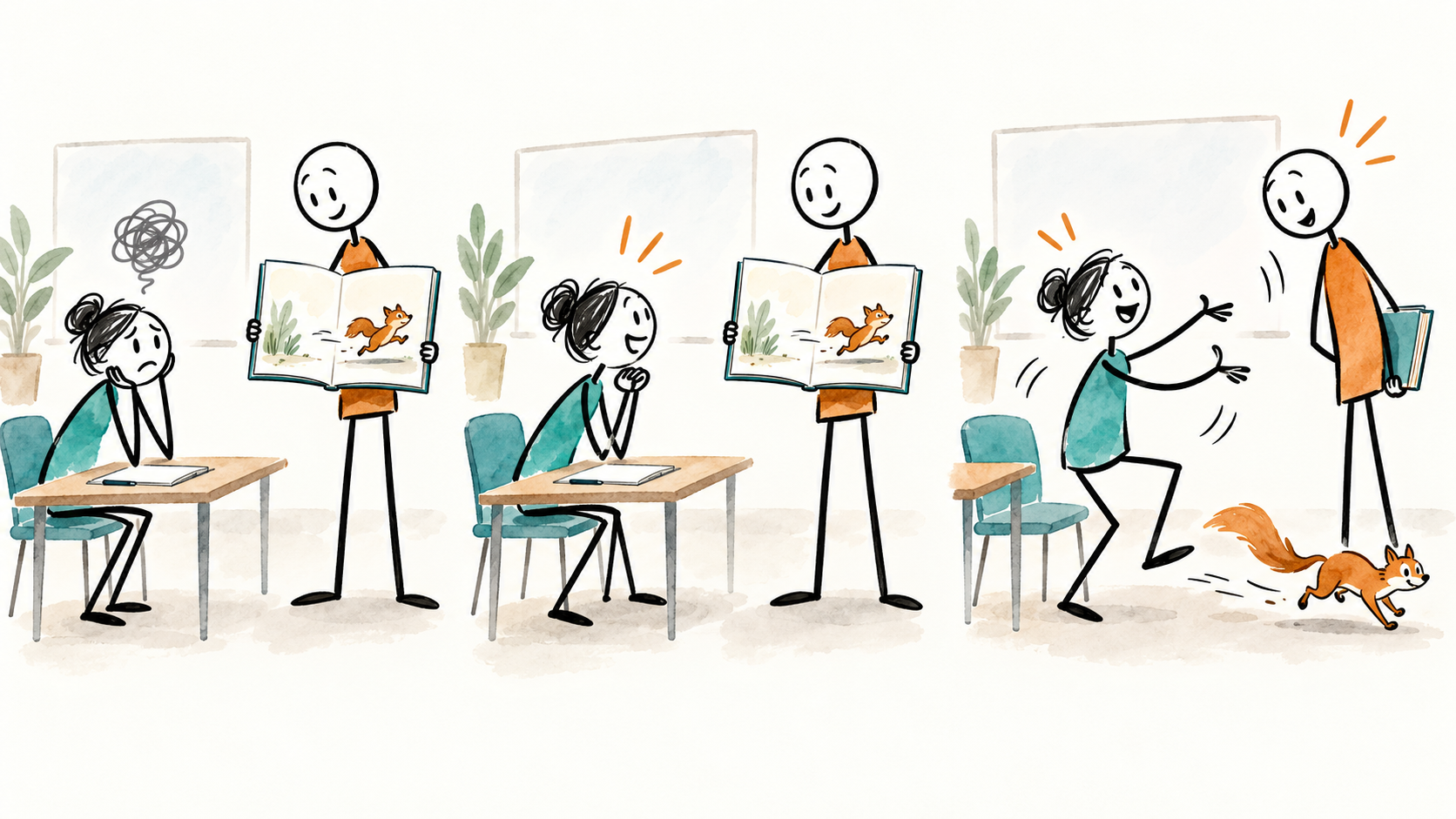
Why repeat the same story?
“We’ve already read it, teacher!”
The student says it as though they have caught the teacher forgetting what was taught in the previous lesson.
Yes, we read it. We learned that a man went out, an animal escaped, and the problem ended in a funny way. Then what?
Close the book and ask the student to recount three sentences about what happened.
They may remember the event but not the verb that expressed it. They may recognize a word when they see it but be unable to say it when it disappears. They may understand a phrase within the story but not know how to use it in another situation.
They know the story, but they have not yet made its language their own.
We have become accustomed to treating progress as synonymous with something new: a new story, a new list, a new lesson. If the same text returns, teachers feel they have offered nothing, and students feel they have made no progress.
But a first exposure is often not enough to learn a word. Recognizing it does not mean being able to recall it, and understanding a story once does not mean the learner has acquired its language.
So why repeat the same story?
Because the first reading may be for the story, while some subsequent readings are for the language.
The first time, we capture the elements of the story
When a beginner reads a story for the first time, their mind is occupied with basic questions:
Who is this character? What happened? Who said this sentence? Why did the man get angry? And where did the animal go?
Meanwhile, many words and structures pass by. The learner understands some from the pictures, guesses others from context, and skips others to avoid losing track of events.
When they return to the story, the plot no longer consumes the same amount of attention. They know who came in and who went out, so they can notice things they missed the first time:
- That the verb was in the past tense.
- That the character said: “ذَهَبَ إِلَى” rather than “ذَهَبَ فِي”.
- That a phrase consists of several words but is pronounced as a single unit.
- That the word they guessed from a picture appeared again elsewhere.
- That a previously unclear sound is becoming clearer.
On the third reading, the student may begin predicting a sentence before it appears, completing it, or saying it along with the character.
Here, the phrase makes a gradual transition:
Unfamiliar ← understood ← familiar ← retrievable.
But this transition does not happen simply by repeating the story three times. On the third occasion, students may look without noticing anything new.
That is why there is little value in repeating the text while repeating the same task.
The text stays the same; the task changes.
How many encounters does a word need to stick?
In a well-known study, Stuart Webb investigated the effect of seeing new words once, three times, seven times, or ten times. One hundred and twenty-one Japanese learners of English participated, and multiple tests measured knowledge of word form, meaning, usage, and relationships with other words.
The results showed that more encounters were accompanied by gains in at least one aspect of word knowledge. Ten encounters led to clear gains, but the researcher still considered that full knowledge of a word might require more than ten encounters (Webb, 2007).
This finding deserves attention.
A student may know that يَحْمِلُ means someone holds and moves something, but may not remember it when speaking. They may recognize it in the present tense, then struggle with حَمَلَ and مَحْمُول. They may know its meaning in isolation but not which words usually occur beside it.
Knowing a word is not an electrical switch: either on or off. It grows in stages.
But the study does not say that every word needs exactly ten encounters, or that we should read the same story ten times. Its words were also invented and appeared in controlled English contexts.
It tells us something simpler:
One correct answer is not sufficient evidence that a word has become established.
Should we repeat the same story or find another one?
This is a more precise question.
In a recent study, forty-two university students learning English read one short story three times and also read three different stories. The target words appeared the same number of times in both conditions, and researchers recorded the students’ eye movements while reading.
When the same story was repeated, students became faster at processing new words, and their recognition of the meanings was better on the immediate test. But this advantage disappeared on the delayed test a week later. Seeing words in different stories did not produce a clear long-term advantage either (Chandy et al., 2024).
What can we infer?
A familiar story may reduce the burden of understanding events, freeing some attention to process language. But it does not, by itself, guarantee that the words will remain days later.
Perhaps it is better to follow a two-stage path:
- Repeat the same story until some of its words become familiar and easy to follow.
- Then revisit the important words in another story, a personal question, or a speaking task.
The first story helps students grasp the word; new contexts help keep the word from remaining captive to the first story.
This is only an inference from the findings, not a recipe tested by the study itself.
Today or next week?
A student may read a story five times in one sitting and master it by the end of the lesson. When they return to it a week later, it may feel as though it never happened.
Should we group repetitions together or space them out?
A study compared seventy-one sixteen-year-old learners of English. Both groups read the same text five times while listening to an audio recording. One group read it once a day for five days, and the other once a week for five weeks.
Intensive repetition produced greater gains on the near-term test, while spaced repetition was better for longer-term vocabulary retention (Serrano & Huang, 2018).
The study involved adolescent learners of English, so we cannot mechanically transfer its numbers to adult learners of Arabic.
But it supports a sound practical principle:
Do not put all the encounters on one day.
You can repeat the story twice or three times during a lesson, then return to a picture from it the following day and to a phrase from it a week later.
A little forgetting is not always the enemy. When students try to retrieve a phrase after it has been absent, we learn whether it remained in their memory or whether they were repeating it because it was still in front of their eyes.
Repetition helps .. Hmm .. Not always
If you tell or play a story four times, then ask after each time:
مَنْ بَطَلُ الْقِصَّة؟
You may have repeated the play button rather than the teaching.
Each encounter should have a new purpose:
- The first time: Follow the story and identify the main event.
- The second time: Notice four repeated words or phrases.
- The third time: Read with the audio and imitate stress and pauses.
- The fourth time: Arrange the pictures and recount the events without the text.
- The later encounter: Recall the phrases or use them in a new situation.
We do not need to do all of this with every story. The point is that the teacher should know: Why am I repeating the text now?
Asking an adult to repeat a story from beginning to end in the same way, then being surprised by their boredom, reveals a problem with the task rather than with the principle of repetition.
Adults may accept a simple story, and even find it comfortable, if each return brings visible progress: a word they can now pronounce, a sentence they can now complete, or a paragraph they can recount.
What do these studies not say?
The studies do not say there is a magic number of readings that suits every student and every word.
Nor do they say that repeating one story replaces extensive reading and exposure to different texts.
Nor do they say that faster reading on the second attempt is sufficient evidence of learning; the student may simply have memorized the sequence of events.
Nor do they say that success on an immediate test means retaining the language a week later.
Nor do they establish that repeated passive listening has the same effect as attentive reading or attempted retrieval.
The studies mentioned were also conducted with learners of English, not Arabic. Arabic has its own features of script, vowel marking, morphology, and diglossia, and we need studies that test repetition directly in its context.
It is closer to the truth to say:
- Seeing a word once is often not enough.
- Repeating a story may reduce processing difficulty in the early stages.
- The task should change whenever we repeat the text.
- The text must sometimes disappear so students can attempt retrieval.
- Spreading encounters across days is more useful than cramming them into one session if our aim is lasting learning in the mind and self.
- The words should then be transferred to new contexts.
Do not ask: Have we finished the story?
Ask instead:
- What can the student say after closing the book?
- Which words can or cannot they recall?
- Are they reading it easily, or merely remembering its position on the page?
- Did the reading task change each time?
- When will they see the phrase again after this lesson?
- Have they used it in a personal question or a new story?
- Does repetition still engage their attention, or has it become mechanical viewing?
With these questions, repetition becomes part of a learning plan rather than a remedy used to fill the remaining minutes of a lesson.
Try this in ten minutes
The idea can be applied using the episode “The Inventor of the Computer, Al-Khwarizmi” from Arab and Proud.
The episode begins with a question close to our contemporary world: What does an ancient Arab scholar have to do with computers and artificial intelligence? This makes it suitable for repeated viewing: on the first viewing, students follow the idea, and on subsequent viewings they can pay attention to the names, terms, and phrases used to build the story.
Then follow these steps:
- First viewing: What is the story?
Watch the entire episode without pausing, then present three short summaries and ask the student to choose the one closest to the main idea.
Do not explain every word. The initial aim is for the student to know who Al-Khwarizmi was and why we are talking about him today. - Second viewing: Catch four phrases
Choose a section no longer than one minute and identify four key words or phrases, such as:
عالِمٌ عَرَبِيٌّ – عِلْمُ الْجَبْرِ – الْخَوارِزْمِيّاتُ – الْحاسُوبُ
The student watches the section again and points to each phrase when they hear it. They can then match each phrase to the appropriate picture or idea. - Third viewing: Complete it before the speaker
Replay the clip and pause before one of the target phrases, then ask the student to predict or complete it.
If they cannot, offer the first word or two choices, then try again without help. - Hide the video
Show a picture of Al-Khwarizmi or write only his name, then give the student these beginnings:
الْخَوارِزْمِيُّ عالِمٌ…
اِشْتَهَرَ بِـ…
نَسْتَعْمِلُ الْخَوارِزْمِيّاتِ الْيَوْمَ فِي…
The student chooses two beginnings and completes them from memory. Do not require a word-for-word repetition of the video. - Transfer the idea to another person
Ask the student to name a scientist or inventor they know, using the same pattern:
هٰذا…، وَهُوَ عالِمٌ مِنْ…، اِشْتَهَرَ بِـ…
Here we test whether the structure has moved beyond Al-Khwarizmi’s story or remains tied to it alone.
The next day, send the student a picture of Al-Khwarizmi from the episode and ask for a voice recording no longer than half a minute. They should use at least two phrases without rewatching the video first.
In this way, we did not repeat the episode. On the first viewing, the student understood the idea; on the second, noticed the language; on the third, recalled it; then tried using it in a new conversation.
Conclusion
We do not repeat a story because we lack new material. We repeat it because exposure is not the same as learning.
If the text disappears and the student can tell the story, the story is no longer the same; this time, the reader is what has changed.
This week’s material: The episode “The Inventor of the Computer, Al-Khwarizmi” from Arab and Proud.
Do you repeat texts with your students? What activity makes the second reading truly different from the first?
Join us in the next newsletter,
The Arabic Simply team